The Overstory
Welcome to The Overstory, the tri-annual publication of forest-centric news produced by The Forest School at the Yale School of the Environment. We are excited to share with you how our community is advancing the field of forestry in all its many forms.
Featured Article: Forests Through Time: Lessons from a Three-Part Yale Forest Forum Series
By: Hassan Alzain ’26 MEM
A Trilogy Inspired by 125 Years of Leadership in Forestry
In 2025, the Yale School of the Environment marked its 125th anniversary, commemorating a legacy that began in 1900 with the founding of The Yale Forest School and evolved into one of the world’s leading institutions for environmental scholarship and practice. Across more than a century, the school has helped shape modern forestry, conservation policy, and interdisciplinary environmental research while educating generations of leaders working on global environmental challenges.
Inspired by this milestone, the Yale Forest Forum convened a three-part speaker series exploring the long arc of forest history and its relevance for the future. The series examined forests across distinct historical eras, from pre-industrial human relationships with forests, to the rise of scientific forestry, to the evolving issues facing forests today. By bringing historians, scientists, and practitioners into conversation across disciplines, the trilogy created a rare opportunity to examine how centuries of ideas, practices, and institutions continue to shape forest stewardship in a time of accelerating environmental change as the field looks toward the next century of practice and innovation.
Part I: A History of People, Forests, and Forestry
The first series, “A History of People, Forests, and Forestry,” ran from January 23 to April 3, 2025, and explored how human societies have interacted with forests since ancient times. The sessions examined the diverse ways cultures around the world shaped forest landscapes long before the emergence of modern forestry institutions. Speakers drew on archaeology, environmental history, and anthropology to bring into focus how forest peoples developed systems of land stewardship grounded in local knowledge, spirituality, and practical ecological understanding, foundations that would later influence evolving ideas about forest management and stewardship.
Drawing from the Americas, Europe, Africa, and Asia, the series highlighted practices such as swidden agriculture, forest gardens, and Indigenous fire management. These traditions demonstrated that forests were not merely natural landscapes but social and cultural systems shaped through generations of interaction between people and place. By examining pre-industrial forest practices, the series emphasized that understanding today’s environmental pressures requires recognizing the long histories of human influence on forest ecosystems.
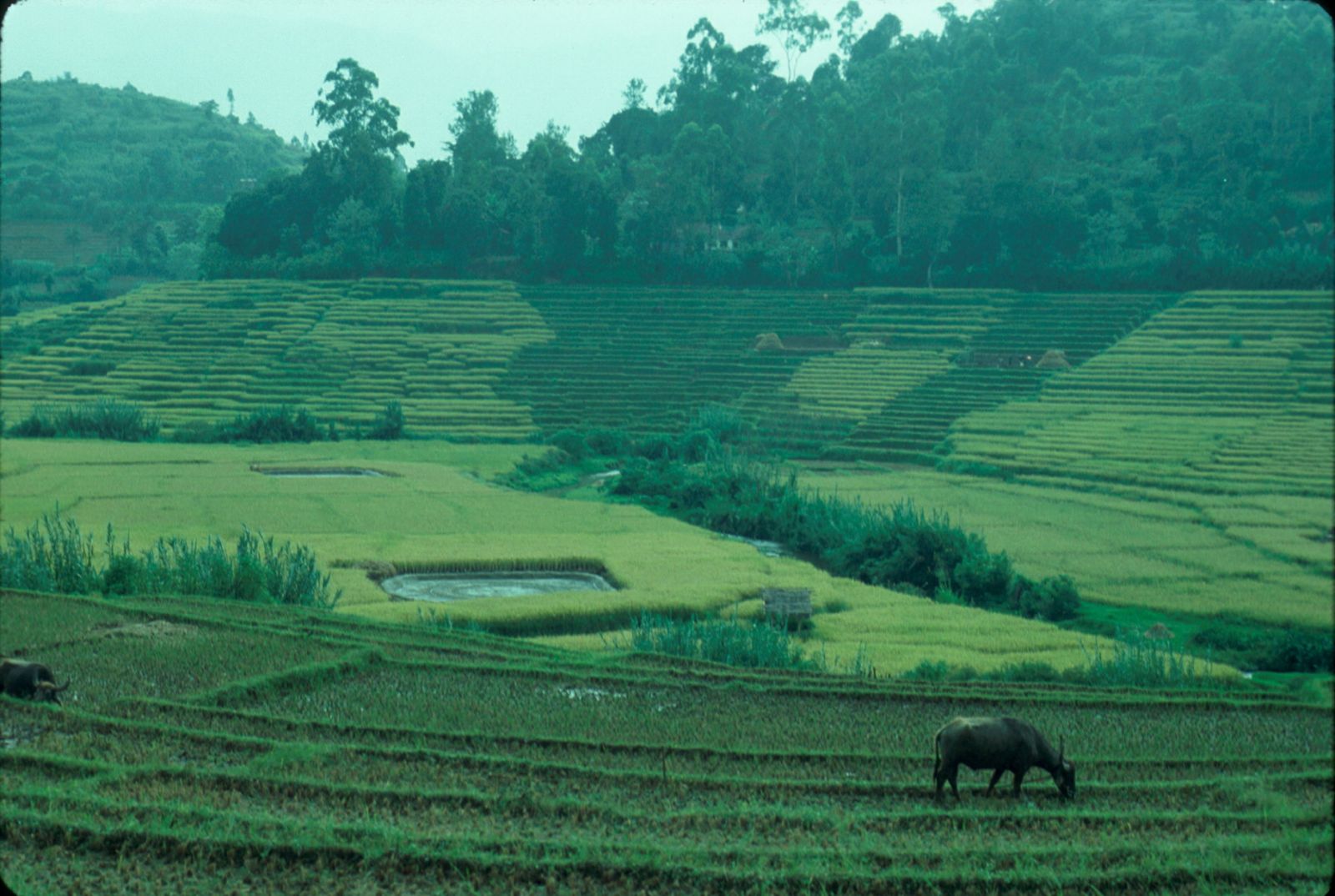
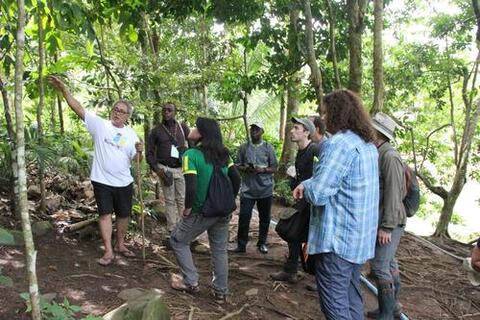
A rain-fed system of smallholder rice paddy cultivation, tree gardens, and a tea farm in Sri Lanka in the 1990s. Credit: Mark Ashton
Part II: A History of Scientific Forestry: From Extraction to Ecosystem Management
The second series, “A History of Scientific Forestry: From Extraction to Ecosystem Management,” took place from September 4 to December 4, 2025, and traced the emergence of forestry as a scientific discipline in Europe building upon earlier relationships between people and forests explored in the first series. The series explored how early-modern European ideas about nature, resource scarcity, and state authority gave rise to systematic approaches to forest management. These models were closely tied to imperial expansion and industrial development, shaping forestry institutions across Europe, Asia, and North America.
Speakers examined how forestry became professionalized through universities, government agencies, and organizations, including The Yale Forest School, the U.S. Forest Service, and the Society of American Foresters. The series also considered the legacies of these systems, including conflicts with Indigenous land use, the transformation of forest landscapes for industrial production, and the eventual shift toward ecosystem-based management in the 20th century. Advances in ecological science, along with landmark environmental legislation of the 1970s, helped move forestry beyond extraction toward approaches that recognize biodiversity, ecological processes, and long-term sustainability, developments that continue to influence contemporary forest governance.

Steam tractor by Best Mfg. Co., 1894 in California. Credit: Caterpillar T. Co., Yale Lantern Slide Collection.
Part III: From Timber to Tomorrow: Old Challenges, New Pressures, Changing Paradigms
The final series, “From Timber to Tomorrow: Old Challenges, New Pressures, Changing Paradigms,” ran from January 20 to April 28, 2026, and focused on the profound transformations that have reshaped forestry over the past half-century building on the historical foundations explored in the second series. Since the 1970s, forestry has expanded beyond production and conservation to encompass multifunctional landscapes that balance ecological resilience, economic demands, and diverse social values.
Through conversations with scholars and practitioners, the series examines how contemporary forestry is responding to climate change, biodiversity loss, wildfire risk, and shifting patterns of land ownership. Sessions explore topics ranging from the sustainability of planted forests and community engagement in forest governance to the emergence of climate finance and the growing role of technologies such as remote sensing and artificial intelligence. The discussions highlight how forestry is adapting to an era in which environmental change, social expectations, and technological innovation are reshaping the field of forestry and redefining the responsibilities of forest stewardship in the future.

Students mark trees for regeneration in California. Photo: Lynn Robb
Connecting Past, Present, and Future Forests
Taken-together, the three series offer valuable perspectives on the evolving relationship between people and forests. The first series situates forests within deep cultural and historical contexts, showing how human societies have shaped – and have been shaped by – forest landscapes for millennia. The second examines how modern institutions and scientific knowledge transformed forests into managed resources within national and global economies. The third brings the story to the present, where forests are increasingly understood as complex systems providing ecological, economic, and social benefits.
This historical viewpoint arrives at a moment when forests are central to global environmental debates. From climate mitigation and biodiversity conservation to sustainable development and Indigenous rights, forests are increasingly recognized as critical to addressing planetary challenges. By examining these trajectories, the Yale Forest Forum provided a platform to reflect on how lessons from history can guide more resilient and inclusive approaches to forest stewardship in the 125 years ahead, underscoring that today’s solutions must continue to draw on both historical insight and scientific innovation developed across centuries.
Overstory Editions

All Overstory Articles