
By: Sara Santiago
Ginseng harvest in the U.S. has been regulated under the Convention on International Trade in Endangered Species since 1975, and the current harvesting rules have been in place since 1999. Yet, national-scale data suggests that wild ginseng populations have declined from factors such as illegal harvesting, land development, and climate change. For Karam Sheban ’20 MF, ’26 PhD and colleagues, this raised the question: are the current regulations designed well, and, if not, how might they be redesigned to better conserve the species?
What prompted your research question around age- versus size-based harvesting of American ginseng and what are your main findings?
The current regulations say a plant must be at least five years old and have three leaves before it’s harvested so that the plant has the chance to produce seeds and repopulate. But research has shown that many 5-year-old plants are not reproductive, and importantly, there’s no reliable way to confirm the harvested plant had three leaves.
We wanted to know whether a different field measurement could be used to determine whether a plant was reproductive, and ideally a measurement that could be verified when those roots — the marketable part of the crop — were being sold. Our main finding, published in Environmental Research Letters, was pretty striking: leaf area explained about 75% of the variation in root mass compared with just 12% for age, or 36% for age and leaf count together, which is essentially what the current rules rely on. Leaf area also predicted whether a plant was reproductive and how many seeds it could produce. In other words, a plant’s size tells you almost everything the regulations are trying to protect for, and age tells you very little.
Do you expect that classifying by size rather than age could change the behaviors in casual or recreational harvesters, not just forest farmers?
If the regulations were to change, this would primarily impact wild harvesters and ideally make the rules easier to follow and easier to enforce. A size-based rule lets someone judge whether a plant is eligible for harvest through a quick measurement of its leaves. And because leaf area is so strongly related to root mass, the measurement taken in the field could be verified after the fact from the mass of the root itself, with state officials checking for compliance at the point of sale in an accurate way.
We suggest that forest farmers could simply be excluded from these rules, which are designed to protect wild plants. Forest farmers have planted ginseng as a crop, and whatever plants they harvest are separate from and additional to wild populations.
Are there any risks associated with only taking larger plants? Is there an upper size limit to avoid “high grading” of ginseng?
Yes, and we make an important caveat in the paper. If a size rule only sets a minimum, it could reinforce a harvesting tendency to take the biggest, most valuable roots, which can shrink the size of plants over generations.
The fix is to borrow from fisheries. The American lobster fishery, for example, uses both a minimum and a maximum size limit — small individuals are protected so they can reproduce, and the largest, most reproductive individuals are protected because they contribute disproportionately to replenishing the population. Applied to ginseng, plants protected below a minimum size would have a chance to set seed and those protected above a maximum size would keep the best reproducers in the ground — leaving a harvestable “window” of commercially valuable plants in between. Enforced at the point of sale, that kind of bracket could ultimately discourage harvesters from taking the very largest plants.
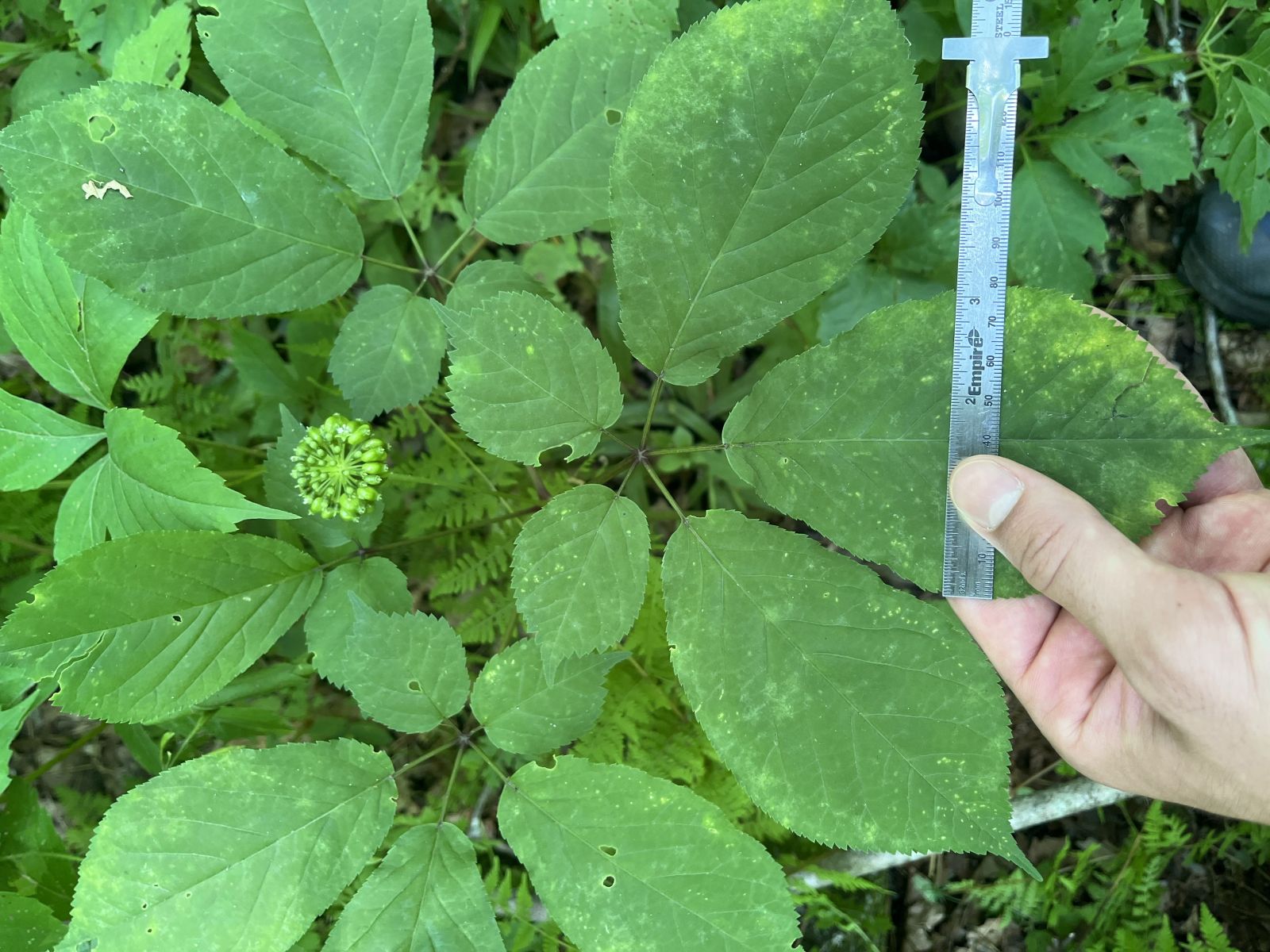
The study uses the approach of measuring leaves in the field without disturbing the plant to determine harvestability. Credit: Karam Sheban
What do you hope the implications of this study will be on harvest regulations?
My hope is that a size-based framework gives regulators a biologically grounded, practical alternative for protecting ginseng. Better aligning the biology and the regulation could head off a drift toward outright harvest bans — which are already appearing, with several National Forests suspending ginseng permits in 2021. I’d also love to see forest-farmed ginseng finally treated as distinct from wild, so the farmers supplying cultivated ginseng from intact forestland — maintaining all kinds of co-benefits provided by that forest — aren’t regulated as if they’re depleting wild populations.
How do you plan to communicate these findings with groups that would act upon them – harvesters, landowners, extension agents, regulators?
From a scientific perspective, our findings are fairly straightforward. From a conservation perspective, the harder and more important work is translation. For wild harvesters and forest farmers, this looks like translating our findings into plain-language guidance and a simple field tool that can be communicated through extension and grower networks, stakeholder groups like the Northeast Forest Farmers Coalition (which I help coordinate), through in-person educational workshops, and via online resource repositories like the Forest Farming YouTube channel.
For regulators, our hope is that our work can be one piece of a larger conversation about policy reform to better support both conservation of wild ginseng and forest farmers at the same time. We make practical suggestions in our paper on potential enforceable mechanisms. I also recognize that there is a significant social and cultural element at play in this conversation: any discussion of policy change should respect the deep tradition of ginseng harvesting and include a diverse set of voices and perspectives.
What do you think the public most commonly misunderstands about sustainable harvesting, and how does your study clarify that?
I think there is a well-meaning impulse to assume that the harvesting of wild plants is inherently extractive, and that conservation should mean leaving these plants entirely alone. With ginseng, much of the harvesting that has taken place over the past few hundred years has caused plant populations to decline. But at the same time, the human use of ginseng and other plants as food and medicine, especially through stewardship by Indigenous communities, helps explain why these species were so widespread in the first place.
In fact, Traditional Appalachian harvest practices basically followed the size-based framework our evidence points to: large seed-producing “mother plants” were traditionally left unharvested in recognition of their important role in replenishing the population. Essentially, our data points to a regulatory framework that would codify the stewardship practices that have been well understood for generations and could better ensure the species’ survival in the future.
Karam Sheban ’20 MF, ’26 PhD is a research assistant professor at the Department of Natural Resources and Environment, College of Life Sciences and Agriculture, University of New Hampshire. Co-authors of the study from The Forest School include Nat Burr ’26 MF, Marlyse Duguid, and Mark Bradford. The research paper can be found at: https://iopscience.iop.org/article/10.1088/1748-9326/ae867c


