By: Mia Ambroiggio ‘26 MEM
Forestry does not solely impact the natural systems we are aiming to manage: it directly impacts the communities that call them home. The connections and interactions foresters have with communities that live on or adjacent to forested landscapes, as well as with Indigenous communities with relations to land since time immemorial, are integral in effective, holistic forest management. How we foster kinship — and whether it is done thoughtfully — is an important aspect of our role as foresters and environmental stewards.
Tribal Nations and communities specifically have faced funding disparities, legal and cultural trauma, diminished staffing, and barriers to technical assistance in the realm of forest management. In terms of funding, there is a $96 million federal funding gap between Tribal forest management and other federal land management agencies, according to the Indian Forest Management Assessment Team’s 2023 report.
However, there has been a recent increase in co-management between Tribes and federal agencies, Tribal workforce development, and Tribal self-determination in the forestry sector. For those of us who are non-Native, or settler, stewards, how we approach building partnerships with Tribal communities who are culturally and historically tied to the land we are working with can lay the foundation for trust-based collaboration. If done thoughtfully and not transactionally, we can assist in alleviating traditional barriers Tribal communities face through collaboration, adding capacity when wanted, and co-cultivating creative solutions when needed.
So, how do we create kinship?
For Joshua Friedlein ‘23 MF, creating lasting partnerships between the Yale School of the Environment and Tribal Nations and intertribal organizations was central in his academic experience at Yale and beyond. Friedlein is an enrolled citizen of ᏣᎳᎩᎯ ᎠᏰᎵ (The Cherokee Nation). During his time at YSE, he was one of the two inaugural teaching fellows — alongside Molly Johnson ’23 MEM — in the “Tribal Resources and Sovereignty Clinic.” This role not only included relationship building with external partners, but within the walls of YSE. “A lot of relationship building happened within the school, to make sure that faculty, or anyone in a position of power, understood the value of this work,” he said, “and that students at the School of the Environment want to understand how to work with Tribes and support #LandBack, they just don’t know how to do it.”
Tribal engagement is not something we are typically taught in settler-led education, including higher education, but when working in forest management — and the environmental sector at large — it’s a crucial skill. How to show up and be a good partner, and how to navigate the space we are taking up as non-Native people, should be a key pillar in our education as environmental stewards.
Friedlein’s most enriching experience during the MF program was getting involved with Yale’s Native American Cultural Center, where he first learned about the Newberry Consortium in American Indian and Indigenous Studies (NCAIS). Through this program, he attended a research workshop in Arizona that focused on seeing the landscape as an archive of settler colonialism, alongside students from across the country and spanning academic disciplines. Friedlein stayed involved with the Newberry throughout his time at Yale, and serendipitously, a public humanities fellowship opened at the time he completed his Master of Forestry degree. The fellowship was a multifaceted public humanities project reasserting the City of Chicago as a Native place now, in the past, and in the future. Friedlein supported public programming and research for the Indigenous Chicago Exhibition. During his fellowship, he collaborated with officials, elders, and knowledge keepers from the 15 Tribal nations that the project partnered with. He emphasized every step of the project involved working with their Tribal partners to ensure the final product was what they wanted to see. To Friedlein, this was “the most meaningful thing [he has] ever done.”
This experience has guided Friedlein in his current role as a Tribal Wildfire Specialist at the University of Minnesota. He is concurrently working on two projects, both of which he provides guidance on Tribal collaboration. In a project where practitioners are experimenting with new silviculture techniques, Friedlein works with project researchers on fostering formalized relationships with the Tribes who live on, live adjacent to, or have ancestral connection to the land this research is being conducted on. “When you think about co-production of knowledge, it requires a real strong relationship [with Tribes], but that’s not something many researchers or foresters are trained to do,” Friedlein explains. His other project focuses on creating a research needs assessment for Tribal forestry practitioners to identify gaps in information surrounding prescribed and cultural burns and wildfire mitigation. Addressing these gaps will inform future research to support Tribal forestry practitioners.
Friedlein credits the foundational knowledge of forest dynamics that he acquired at The Forest School at YSE for distinguishing him as a candidate for the positions he’s held since graduating. Additionally, learning how plant communities work together and collectively grow helped him understand himself within the space of academia and as a practitioner. As The Forest School left its mark on Friedlein, Friedlein’s insight on the importance of Tribal collaboration has since shaped The Forest School. “Joshua was a catalyst for a lot of things at The Forest School,” says Marlyse Duguid, Thomas J. Siccama Senior Lecturer in Field Ecology and director of research at Yale Forests.
Yale Forest Forum Speaker Series on Tribal Forestry
As Friedlein and his classmates were discussing the need for Tribal curriculum at The Forest School at YSE, Yale faculty and staff were planning ways to begin filling this knowledge gap. “A lot of students want to work with Tribes… [and] there is a lot of room for us to provide well trained foresters, but preferably some who have social competency and knowledge of federal Indian law, and we didn’t have that,” says Duguid.
As a result, The Forest School dedicated their spring 2024 Yale Forest Forum speaker series to “Tribal Forestry: Understanding Current Issues and Challenges.” The webinar and seminar series featured topic experts exploring trust-responsibility, co-stewardship, and rebuilding connections with Tribal communities. The series was co-developed and co-hosted by The Forest School, Yale Center for Environmental Justice, and Salish Kootenai College. The series was co-hosted and co-instructed by Duguid, Gerald Torres, Dolores Huerta and Wilma Mankiller Professor of Environmental Justice, and Adrian Leighton ‘96 MF, professor of forestry at Salish Kootenai College. The seminar portion included master’s students enrolled at YSE and SKC.
Guest speakers ranged from Indigenous fire ecologists from the Bureau of Indian Affairs to members of the Intertribal Timber Council to staff and faculty from various universities. The series first contextualized the need for Tribal sovereignty and co-stewardship in forestry practices before exploring opportunities, barriers, progress, and gaps in the current state of Tribal forest management.
Throughout the series, there was a clear consensus that connection and personal relationships are integral to effective Tribal forest management. Monique Wynecoop (Atsugewi / Mountain Maidu), tri-regional fire ecologist at the Bureau of Indian Affairs, who spoke on Tribes and fire ecology, said “It is a personal commitment to [actually] go out and make these relationships and maintain them. It’s not a one-time thing” during her YFF presentation. While partnerships can, at times, feel transactional, true relationship building with community members should be anything but. Wynecoop’s role with the Bureau of Indian Affairs focuses on building and strengthening transparent communication with Tribes to foster trust and support Tribal community wellness and sovereignty. “[This is] precisely the kind of work that could make Tribal co-management a reality,” says Torres. “It brought together Native and non-Native experts and reached an audience of Native graduate students, as well as those interested in Tribal resource issues.”
For Salish Kootenai and Yale students alike, learning about Tribal contexts at a graduate level and merging cohorts to learn collaboratively was an invaluable experience. “It was important for both sides,” said Adrian Leighton. Leighton described that while The Forest School cohort is typically diverse and varied in backgrounds and perspectives, most students at Salish Kootenai have grown up and reside in the Intermountain West, bringing deep, rich knowledge of place and community. This allows a great opportunity for knowledge sharing and relationship building, which occurred when Salish Kootenai students traveled to New Haven to meet the students they were learning alongside. “Seeing the beginnings of meaningful exchanges between Salish Kootenai and Yale students was amazing,” says Leighton, “and some of them still keep in touch.”

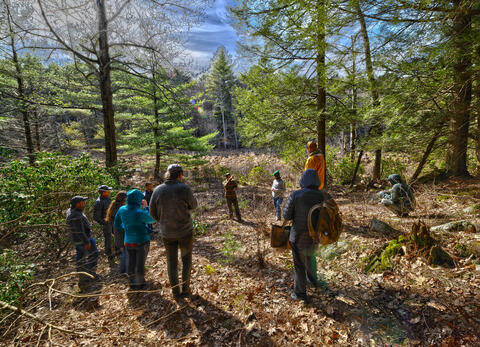
Yale School of the Environment and Salish Kootenai College students, staff, and faculty explore a trail at Yale-Myers Forest during a forest ecology walk. Photo: Mark Conrad
Looking Ahead at The Forest School
Being in an academic space, we must intentionally choose to be a community of scholars and practitioners who advocate for Indigenous sovereignty and the co-production of knowledge, as our current systems do not inherently support that work. As described by Duguid, “the shift towards [thinking about] earth’s original stewards and traditional ecological knowledge is much more recent, most likely due to the same colonial legacies which affect most universities and is especially present here. We are not exempt from it.”
Duguid is hopeful for the thoughtful integration of programs and curriculum that will allow students to learn more about Tribal forestry and collaboration. “When it comes to place-based connection to land, we have always thought about forests in a kinship way at The Forest School.” She notes that the ethos of the school is not extractive, rather to understand the land, history, and people who have connections to that land. She references the breadth of community-focused forestry practices that come out of the school’s programming, such as neighborhood tree plantings through the Urban Resources Initiative; empowering landowners with collaborative restoration solutions in Brazil, Colombia, Panama, Indonesia, and the Philippines through the Environmental Leadership & Training Initiative; and ensuring inclusive, community-centered management and conservation through The Forests Dialogue. However, when it comes to kinship, Duguid emphasizes the need for genuine relationships. While graduate students at Yale are ephemeral, the relationships the school builds with Indigenous communities must be grounded in trust and authenticity, built over time, and not transactional. While collaboration at The Forest School is expansive, crafting kinship is both personal and, at times, private.
What must be centered in this work is kinship itself, and the value that connection and trust can bring to working relationships. As the school continues to navigate the development of coursework, programming, and opportunities that allow students to learn about collaboration and co-stewardship with Tribal communities, we can work collectively to be both good stewards and good partners.
To watch Yale Forest Forum’s series on Tribal Forestry, visit https://yff.yale.edu/speaker-series/tribal-forestry-understanding-curren…


