
By: Cameron McKenzie ’23 MFS
At pivotal moments in the stewardship of our nation’s forests, the American Forest Congress convenes to chart the path forward through collaborative discussion and collective action. Over the past 145 years, it has met nine times. The first gathering helped create the USDA Forest Service. In the wake of federal restructuring — and amid the censoring of the vocabulary and frameworks needed to discuss the deeply intertwined social and environmental challenges facing our nation and future generations — the Congress fittingly convened for its ninth session.
I had the privilege of attending the 9th American Forest Congress as a research associate with the Yale Applied Science Synthesis Program (YASSP). Only a few months earlier, I expected to attend as a community engagement specialist and Presidential Management Fellow with the USDA Forest Service. Amid the restructuring of the Forest Service and the federal Pathways programs, I found myself back at The Forest School instead. With so much change, I worried my expectations might be unrealistic — that anything short of reparation and restoration would feel insufficient.
As if anticipating this burdensome expectation, the Congress began with a keynote from Dr. Nalini Nadkarni, a canopy ecologist who informed my master’s work at The Forest School. She reminded nearly 500 attendees that in the wake of disturbance, a return to what was — especially without intervention — is unlikely if not impossible. However, while disturbance uproots normalcy and can fundamentally reshape communities (of people and plants alike), over time, with deliberate care, something new and wonderful can emerge.
That framing proved prescient. The Congress did not attempt the impossible, but through collaboration it achieved the improbable. It rekindled hope, reaffirmed the value of democratic practice at a time when both feel in short supply, and charted an actionable path forward amid rapid change. The tone throughout was pragmatic rather than nostalgic: an acknowledgment that the way ahead will not replicate the past but can still be guided by shared principles and a commitment to collective stewardship.

YSE alum Carrie Sargeant ’02 MF (center) and Cameron McKenzie ’23 MFS (right) discuss the future of urban forestry legislation during an open dialogue session.
The hallmark of the meeting was its focus on action. Beyond a rich slate of sessions, the three-day principles and resolutions process brought forest stewards from across the country together to articulate core principles for forest stewardship and adopt resolutions to uphold them. Being in the room reinforced that collaboration, open dialogue, and debate can yield consensus — and that diversity of people, experiences, and knowledge is central to democracy, not an add-on.
Outside of the principles and resolutions room, hope was nurtured in many ways. A highlight was the plenary session led by U.S. House Representatives Bruce Westerman ‘01 MF (R-AR), Jimmy Panetta (D-CA), and Scott Peters (D-CA). Their bipartisan support for our nation’s forests, including the Save Our Forests and Save Our Sequoias acts, signaled that meaningful progress can still find common ground. The conversation did not gloss over complexity; rather, it acknowledged the real constraints facing forest policy while insisting on the urgency of stewardship that is scientifically informed, community-engaged, and future-oriented.
Patrick Holmes ‘08 MEM (left) facilitates as members of the YASSP team Cameron McKenzie and Sara Kuebbing, Bryan Petit ‘05 MF, and others contribute to the principles and resolutions discussion. Photo: American Forests
Moments of reflection also stood out. Sara Kuebbing, research director of YASSP and a member of the Congress’s steering committee, offered an image that has stayed with me: she likened Congress attendees in the dimly lit basement of the Omni Hotel, to the roots of a disturbed tree in the soil — establishing the foundation for the emergence of something new in the aftermath of disturbance. The metaphor captured both the fragility and the strength of this moment: the sense of upheaval, but also the quiet, resilient work beneath the surface that allows something new to take hold.
Overall, the 9th American Forest Congress stressed that, like forests, we must be resilient in the face of change. The path forward for stewarding our nation’s forests is clearer as a result. I encourage those who were not able to attend the Congress to read the Principles and Resolutions developed during this convening and to reflect on how you might align them with your work as we continue our collective journeys in forest stewardship.

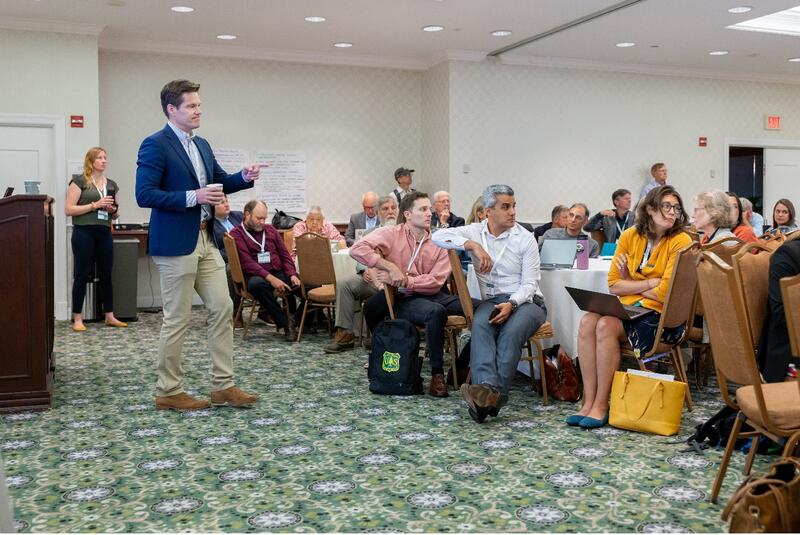
Sara Kuebbing, research director of YASSP, reflects on the progress being made at the 9th American Forest Congress. Photo: American Forests


